A doorway can change how an entire room feels. In the barn door vs hinged door decision, the right choice is not simply about following a design trend. It affects the usable floor area, how much sound travels between rooms, the level of privacy you get, and the character of the finished space.
For homeowners planning a renovation, new build, or room update, both options can deliver an exceptional result when they are selected for the right setting and fitted with precision. The key is understanding where each door works best – and where its limitations may matter.
Barn door vs hinged door: the practical difference
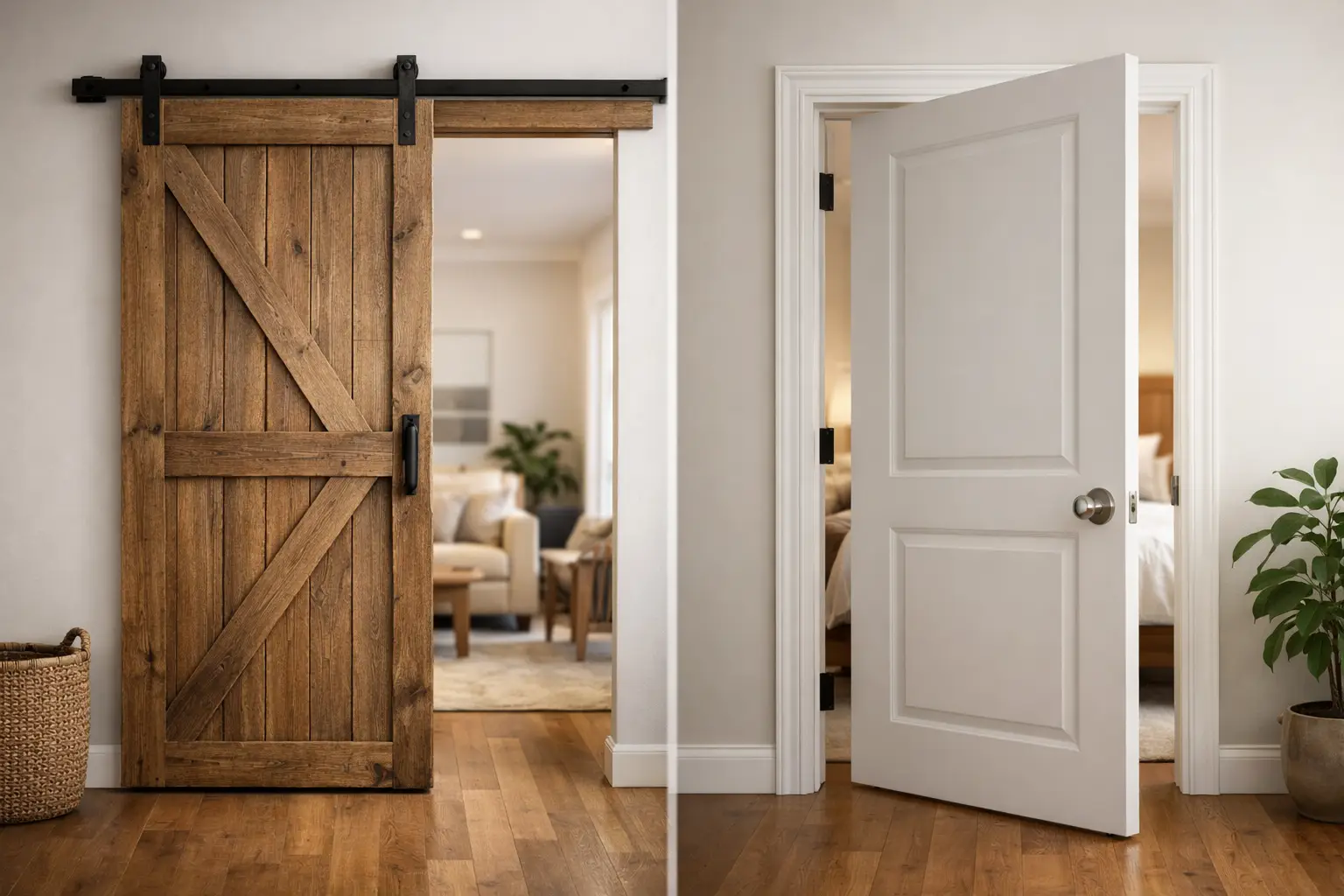
A hinged door is attached to a jamb with hinges and swings into or out of a room. It is the traditional choice for bedrooms, bathrooms, closets, offices, and entryways because it closes firmly against stops within the frame.
A barn door is mounted on a visible track above the opening and slides across the wall beside it. Rather than requiring swing clearance, it needs clear wall space for the door panel to travel. The hardware is part of the design, creating a strong architectural feature rather than disappearing into the background.
This difference in operation shapes nearly every consideration that follows. A hinged door uses floor space when open. A barn door preserves that floor space but claims a section of adjacent wall. Neither is automatically better. The best fit depends on the room, the layout, and how the door needs to perform every day.
When a barn door is the better choice
Barn doors are especially effective where a swinging door would compete with furniture, cabinetry, or a narrow passage. They can make a compact laundry, pantry, walk-in closet, study, or living area feel more open because there is no door arc intruding into the room.
They also offer a distinctive visual result. A shaker-style panel can bring a clean, tailored look to a contemporary interior, while a timber door with visible grain and darker hardware can add warmth and texture. For wider openings, double sliding barn doors can create a considered transition between a dining room and lounge area or between a main bedroom and dressing room.
The practical advantage is strongest when the wall beside the opening would otherwise remain clear. A well-proportioned barn door gives that blank wall purpose and turns an everyday doorway into a design element. It can also be easier to operate than a conventional door for someone carrying laundry baskets, shopping bags, or other items through a busy part of the home.
Barn doors are not limited to rustic interiors. The result comes down to the door profile, finish, hardware, and installation detail. A refined painted door with slim black track hardware feels very different from a heavily distressed timber panel. Choosing components that suit the rest of the home is what makes the feature look intentional.
The limits of a barn door
A sliding barn door does not form the same seal as a hinged door. Small gaps around the edge are normal, which means more sound, light, and odors can pass between spaces. That may be perfectly acceptable for a pantry or wardrobe, but it can be a drawback for a bathroom, a nursery, or a home office used for private calls.
Wall space is also non-negotiable. The door needs enough unobstructed room to slide fully open, without covering switches, outlets, artwork, windows, or built-in storage. In some layouts, a barn door also overlaps trim or competes with nearby cabinetry. A site measure before ordering is essential.
Quality hardware and accurate installation matter just as much as the door itself. The track must be securely fixed to appropriate structure, the panel must be correctly sized to cover the opening, and stops and guides need to be set for quiet, controlled movement. A barn door that is poorly aligned can look unfinished and become frustrating to use.
Why hinged doors remain the standard
Hinged doors are still the most versatile choice for good reason. When closed, they sit within the jamb and create a more complete barrier between rooms. This provides better privacy, improved sound control, and a more familiar feel in rooms where people expect to close the door fully.
Bedrooms and bathrooms are usually the clearest examples. A properly fitted hinged door helps reduce household noise, blocks more light, and offers a reassuring level of separation. For a main bedroom, guest room, powder room, or work-from-home office, those everyday benefits often outweigh the space-saving appeal of a sliding panel.
Hinged doors also suit openings where the adjacent wall is occupied by furniture, windows, shelving, or electrical fittings. They can be designed in almost any style, from simple flush internal doors to detailed shaker designs, glazed French doors, and solid statement entrance doors. The opening direction can be planned around circulation so the door feels natural to use rather than obstructive.
From a maintenance perspective, hinged doors are straightforward. Hinges may occasionally need adjustment, but the system is familiar, durable, and easily integrated with standard locks, privacy sets, and latch hardware. This makes them a dependable choice for high-use areas and light commercial spaces where performance matters as much as appearance.
The trade-off with hinged doors
The swing path needs to stay clear. In a tight bathroom, hallway, or utility room, that can create a genuine layout problem. A door that opens into a narrow corridor can interrupt traffic, while one that swings into a small room may limit where fixtures or storage can go.
The solution is not always to abandon a hinged door. Reversing the swing direction, choosing an outswing configuration where appropriate, or revising the room layout may preserve the privacy and acoustic benefits. Still, when every inch of floor area counts, a barn door can be the more practical answer.
Compare privacy, sound, and safety before choosing
The visual decision is often easy. The functional decision deserves more thought.
For privacy, hinged doors generally win. Their perimeter seal and latch system make them more suitable for bathrooms, bedrooms, consulting rooms, and spaces where occupants need a door to close securely. Barn doors can be fitted with privacy locks, but they do not close in the same way as a conventional hinged door.
For sound control, the same principle applies. Solid-core hinged doors, correctly fitted into quality jambs, can make a noticeable difference in a busy household. A barn door may soften sightlines and create separation, but it should not be chosen where acoustic performance is a priority.
For accessibility and daily use, consider who will use the room. Barn doors have no swing arc, which can improve maneuvering room, but the track and handle arrangement must be easy to reach and operate. Hinged doors may be more intuitive for guests and can offer a wider, unobstructed opening when planned correctly.
For homes with young children, look closely at hardware quality and safety details. Barn doors should have properly installed guides and stops to prevent the panel from swinging away from the wall or traveling beyond the track. Hinged doors benefit from well-fitted hinges, secure latches, and appropriate clearance to avoid pinch points.
Style, materials, and the finished result
Door selection should relate to the architecture and finishes already in the home. A statement barn door can look exceptional in an open-plan renovation, but only when its scale suits the opening and the finish has a clear connection to nearby cabinetry, flooring, trim, or hardware.
A painted shaker barn door can coordinate beautifully with shaker kitchen cabinetry. A natural timber option may complement timber flooring or a warm neutral palette. For a more minimal interior, a smooth panel and discreet hardware can keep the look crisp without making the doorway overly dominant.
Hinged doors offer just as much design potential, particularly when paired with quality architraves, door jambs, and matching skirting. These surrounding details create the clean lines that make an internal door feel properly integrated. In a renovated home, consistent door profiles and hardware across key rooms often deliver a stronger overall result than one dramatic feature chosen in isolation.
Material selection affects performance as well as appearance. Solid or solid-core doors typically feel more substantial and provide better acoustic separation than lightweight hollow options. In humid rooms, appropriate finishes and careful fitting help support long-term durability. A professional measure ensures the panel thickness, clearances, hardware, and frame details work together.
Make the decision room by room
Rather than choosing one door type for an entire property, assess each opening on its own merits. A barn door may be ideal for a laundry or pantry, while hinged doors remain the smarter choice for bedrooms and bathrooms. French doors may suit a study that needs light and flexibility, while bi-fold doors can solve a different storage or access challenge.
Before committing, stand in the room and picture the door open and closed. Check the path of people moving through the space, the placement of furniture, the available wall width, and the level of privacy required. These simple checks reveal more than a product photo ever can.
A carefully selected door should feel easy to live with long after the renovation is complete. Whether the answer is a sliding barn door or a precisely fitted hinged door, quality materials and skilled installation are what turn a functional opening into a lasting part of the home.