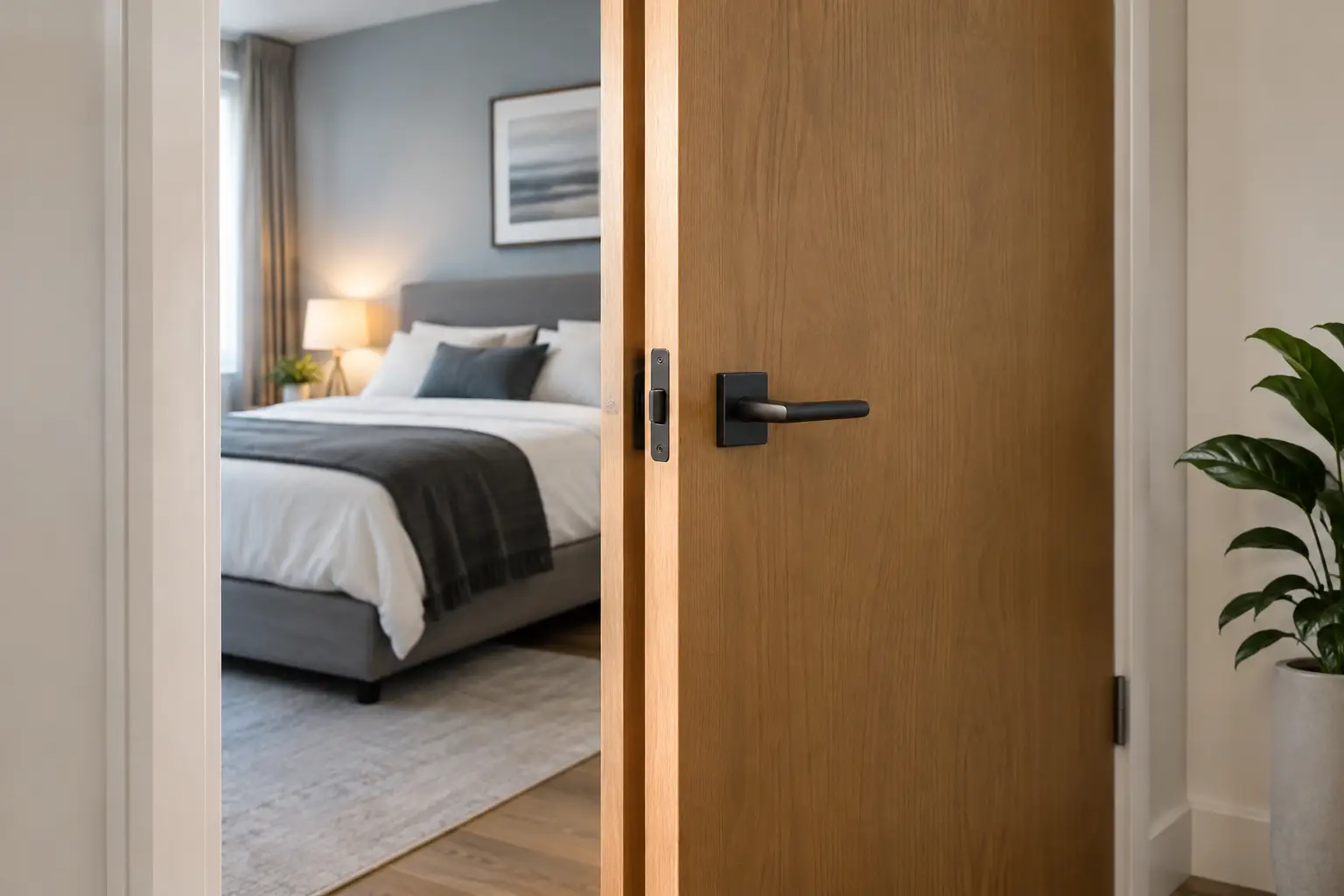
A bedroom door can look substantial and still do very little to stop sound. If conversations from the living room, television noise, laundry cycles, or early-rising family members are traveling straight into the bedroom, the issue is often the door assembly rather than the walls. The best soundproof bedroom doors combine a dense door leaf with tight perimeter seals, a properly fitted jamb, and professional installation that leaves no easy path for sound to pass through.
For homeowners planning a renovation, creating a nursery, setting up a home office, or simply improving privacy between rooms, this is a practical upgrade with a noticeable everyday benefit. The result should feel considered as well as quiet: a door that suits the home’s interior, closes smoothly, and provides dependable separation when it is needed.
Why Bedroom Doors Let So Much Noise Through
Sound follows air. Any gap around a door – at the sides, across the top, or under the threshold – gives airborne noise a direct route into the room. A lightweight hollow-core door also vibrates easily, allowing sound energy to pass through its panels far more readily than a heavier construction.
This is why replacing a hollow-core door with a heavier option can help, but does not always solve the problem on its own. A solid door with a large gap beneath it may still allow voices, music, and general household activity into the bedroom. In many homes, careful sealing delivers an improvement that feels greater than expected because it addresses the most obvious leakage points.
There is also a difference between reducing noise and eliminating it. A well-specified internal door can make a bedroom calmer and more private, particularly against speech and common household sounds. It cannot fully block low-frequency bass, impact noise from footsteps above, or sound that is also moving through shared walls, ceilings, ductwork, and windows. Setting that expectation early leads to a better result.
What Makes Soundproof Bedroom Doors Effective
The most effective door is not necessarily the thickest or most expensive option. It is the one designed and fitted as a complete system. Door weight, construction, frame condition, hardware, and seals all play a role.
Start with a solid core
A solid-core internal door is usually the right foundation for bedroom privacy. Its engineered core is denser than the cardboard honeycomb construction found in many hollow-core doors, which helps it resist sound transmission while delivering a more substantial feel in daily use.
Solid timber doors can also offer good acoustic performance due to their mass, although their appearance, cost, and movement characteristics should be considered in relation to the room and climate. For many residential projects, a quality solid-core door provides an excellent balance of sound reduction, durability, finish options, and value.
Hollow-core doors remain suitable for some low-priority spaces, but they are rarely the right choice where rest, privacy, shift work, or focused work are important. If noise is a recurring frustration, upgrading the door leaf is usually more worthwhile than adding decorative treatments to a lightweight existing door.
Seal the perimeter properly
A door only performs as well as its gaps allow. Compression seals around the jamb close the fine spaces at the head and sides while keeping the door easy to operate. The seal needs to meet the door evenly, without creating excessive pressure that makes latching difficult.
The bottom gap deserves equal attention. A simple door sweep can reduce leakage, though higher-performance options such as an automatic drop seal can produce a cleaner, more reliable result. These seals lower into place when the door closes and lift clear of the floor when it opens. They are especially useful where the floor is uneven or where a standard sweep would drag across carpet or hard flooring.
A threshold may also be appropriate in some applications, particularly when paired with a drop seal. For a standard bedroom, however, the detail should be chosen carefully to avoid creating an unnecessary trip point or interrupting flooring continuity. The best solution depends on the room’s floor finish, clearance, and how the door is used.
Use a stable jamb and accurate clearances
An acoustic upgrade can be undermined by a loose jamb, uneven reveal, warped frame, or poorly aligned strike plate. If the door does not pull firmly and consistently into its seals when closed, noise control will suffer.
This is where precise fitting matters. The hinges must support the extra weight of a solid-core door without sagging, the latch must engage cleanly, and the clearances must be even around the opening. A heavy door also requires suitable hinges and fixings. Simply hanging it on the hardware intended for a lightweight hollow-core leaf can lead to poor operation over time.
Consider the door’s sound rating in context
Some doors are supplied with acoustic ratings, often expressed as Sound Transmission Class, or STC. A higher number generally indicates better resistance to airborne sound, but ratings should be compared carefully. Laboratory figures are achieved under controlled conditions and may not reflect the performance of an installed door with gaps, unsealed penetrations, or a different wall construction.
For most bedrooms, a solid-core door combined with quality perimeter seals and a bottom seal is a sensible, high-value specification. A higher-rated acoustic door may be justified for a music room, a media room, a consulting space, or a bedroom next to a particularly active living area. In these situations, the surrounding partition should also be assessed so the door does not become the only upgraded element in a noisy wall.
Choosing a Style Without Sacrificing Privacy
Sound control does not require an industrial-looking door. Shaker profiles, flush doors, and selected timber designs can all work well when built with a solid core and installed with the right sealing details. A flush solid-core door often offers the simplest path to strong acoustic performance because its construction is continuous and its clean face suits both contemporary and traditional interiors.
Glazed French doors, louvered doors, and open-panel designs are usually less suitable for bedrooms where privacy is the priority. Glass can be specified in acoustic forms, but it changes the cost and design requirements considerably. Louvers and open gaps, on the other hand, are intended to allow airflow and will also allow sound through.
If ventilation is a concern, avoid assuming that a large undercut beneath the door is the only answer. Bedrooms may need airflow for heating and cooling systems, but the required approach varies by home. A door professional can help coordinate the desired acoustic improvement with the room’s practical ventilation needs rather than solving one issue by creating another.
Should You Upgrade the Existing Door or Replace It?
If the current door is solid, straight, and well fitted, adding perimeter seals and improving the bottom seal may be the most efficient first step. This can be particularly effective when the main complaint is audible speech from nearby rooms or a television heard after the door is closed.
Replacement makes more sense when the existing door is hollow-core, damaged, warped, too thin for suitable hardware, or poorly matched to the frame. It is also the better opportunity to improve the room’s appearance with a coordinated door, jamb, architraves, and hardware selection.
In older homes, the frame itself may need attention before any new door is fitted. Trying to force a premium door into an out-of-square opening can result in uneven gaps and disappointing performance. A tailored supply-and-install approach avoids this common compromise by treating the opening, door, seals, and hardware as connected parts of the same project.
Common Mistakes That Limit Results
The most frequent mistake is focusing only on the door slab. A dense new door helps, but it cannot compensate for a wide bottom gap or unsealed jamb. Another is adding bulky adhesive foam that prevents the door from closing or deteriorates quickly with use. Quality seals should be durable, discreet, and correctly compressed.
It is also easy to overlook hardware. Loose hinges, rattling latch components, and a strike plate that does not hold the door snugly closed all reduce the sense of solidity and privacy. Finally, avoid treating a door as the answer to every noise issue. If sound is coming through a shared wall, ceiling cavity, window, or air vent, the bedroom may need a broader acoustic plan.
For a quieter bedroom, start with the path sound is most likely taking. A properly selected solid-core door, fitted squarely and sealed with care, can change how private and restful the room feels every time the door clicks shut.
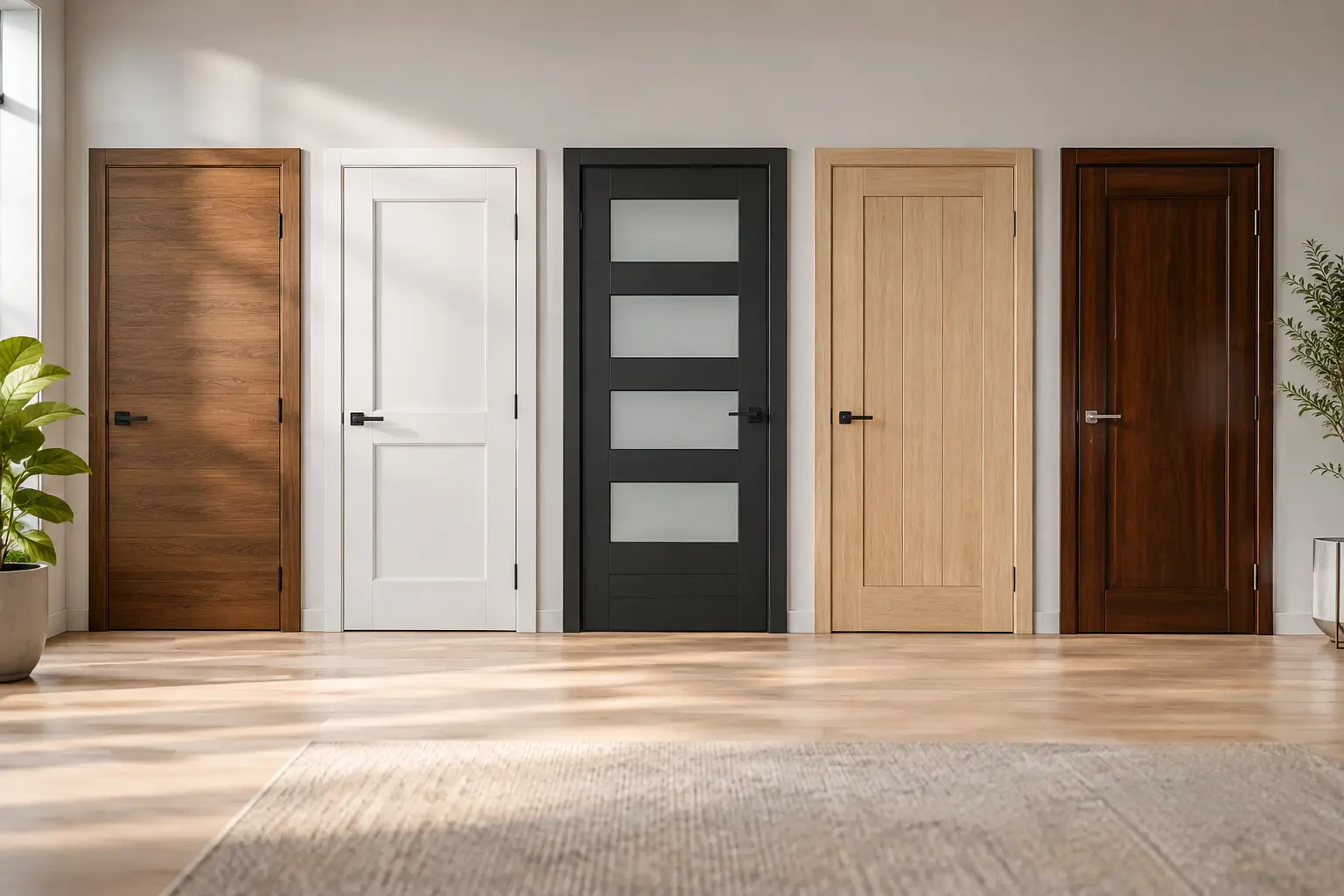
Door Material Comparison for Better Home Choices
A practical door material comparison for homeowners weighing timber, fiberglass, steel, and composite doors for style, security, upkeep, and lasting value.