
A bedroom door that lets every conversation travel down the hall can make an otherwise well-finished home feel less private. That is where the hollow core vs solid core decision becomes more than a line item in a quote. The right internal door affects how a room sounds, feels, functions, and holds up to daily use.
For homeowners, renovators, builders, and property managers, neither option is automatically best. A hollow core door can be a smart, economical choice in the right location. A solid core door offers a noticeably more substantial result where privacy, noise control, and durability matter. Understanding the difference early helps create a more considered finish and avoids spending money where it delivers little practical benefit.
What Is a Hollow Core Door?
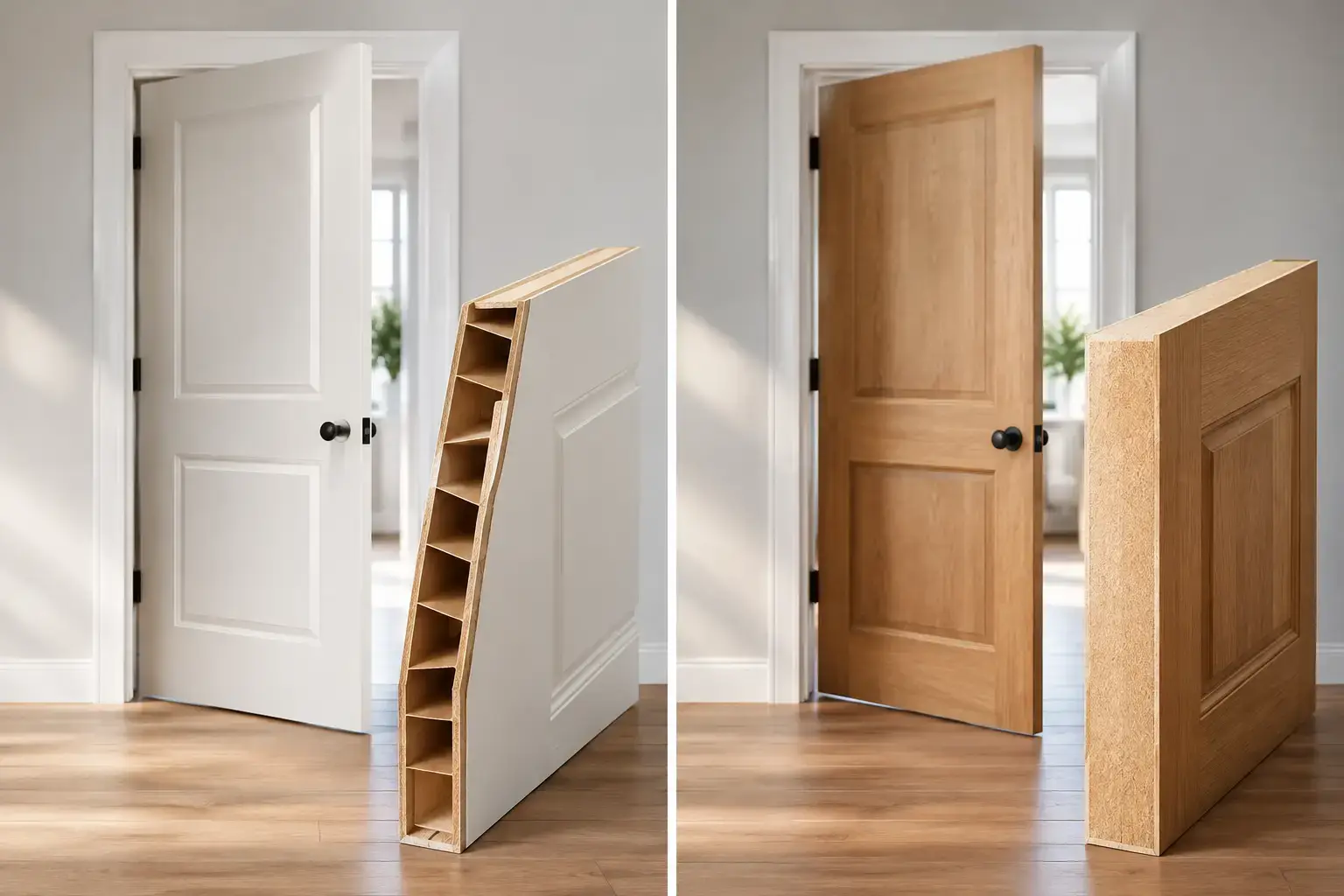
A hollow core door is a lightweight internal door with a timber frame around the perimeter and a thin face skin, commonly hardboard, MDF, or molded composite. The center is not completely empty. It is typically supported with a honeycomb-style cardboard core or a series of lightweight internal blocks that help the door keep its shape.
This construction makes hollow core doors easy to carry, economical to purchase, and straightforward to install. They are widely used in new builds and investment properties because they provide a clean, functional division between rooms without adding unnecessary cost.
Their light weight can also be useful when replacing doors in an existing home. Standard hinges and jambs are generally well suited to them, and the door is easier to operate for children or older residents.
The compromise is in the feel and performance. Knock on a hollow core door and it tends to sound light because it is. It offers limited sound reduction, is more vulnerable to dents and punctures, and has less material available for repairs or changes such as relocating door hardware.
What Is a Solid Core Door?
A solid core door has a dense engineered core, often made from particleboard, MDF, or a composite timber material, finished with a molded skin, paint-grade face, or timber veneer. Despite the name, a solid core door is not necessarily a solid timber door. Solid timber doors are a separate premium category, with their own visual appeal, weight, movement considerations, and cost.
The dense center is what gives a solid core door its defining qualities. It feels heavier in the hand, closes with a more reassuring sound, and provides better resistance to everyday bumps and wear. It also reduces the transfer of normal household noise more effectively than a hollow core alternative.
For a well-appointed renovation, those details are easy to notice. A solid core door does not just look finished once it is painted or styled with quality hardware. It has the weight and presence to match the rest of the space.
Hollow Core vs Solid Core: The Differences That Matter
The most visible difference between hollow core vs solid core doors is usually the price, but the better comparison is how each door performs over years of use.
Sound and privacy
Solid core doors are the stronger choice for privacy. Their dense construction helps dampen voices, television noise, music, and activity from nearby rooms. They will not make a standard bedroom completely soundproof, because sound also travels through gaps around the door, the undercut, walls, and ceilings. Still, compared with a hollow core door, the improvement is meaningful.
This makes solid core doors especially worthwhile for bedrooms, home offices, media rooms, nurseries, bathrooms, and shared living spaces. For homes with shift workers, teenagers, young children, or frequent guests, they can make day-to-day living more comfortable.
Hollow core doors can be perfectly suitable for linen closets, storage rooms, secondary wardrobes, and areas where privacy is less of a concern. In these locations, paying for added mass may not offer the same return.
Durability and repairability
Internal doors receive more impact than many homeowners expect. Vacuum cleaners clip edges, children push doors open too quickly, furniture gets moved, and handles are pulled thousands of times. A solid core door is better equipped for this kind of use. Its dense interior gives it greater resistance to dents, holes, and warping from normal handling.
Hollow core doors are not fragile by default, but damage is harder to disguise when the thin face is punctured. A minor surface scuff may be repairable, while a deeper hole can require extensive patching or replacement. In rental homes and busy family households, solid core doors often deliver better long-term value because they tolerate more use.
Weight, hinges, and installation
A solid core door is considerably heavier. That weight is a positive when it comes to feel, acoustic performance, and durability, but it also means the door must be fitted correctly. Quality hinges, a sound jamb, accurate clearances, and secure fixing are essential to prevent sagging, rubbing, or poor operation over time.
This is one reason professional installation matters. A door may appear simple, but its performance depends on details that are easy to overlook: the hinge positions, latch alignment, jamb condition, floor clearance, handle preparation, and the consistency of the reveal around all sides.
Hollow core doors place less demand on hinges and framing and are easier to maneuver during installation. That can reduce labor in a simple replacement project. However, lightweight construction also means hardware needs to be located within the door’s reinforced lock block. Drilling or cutting outside the intended area can weaken the door.
Cost and value
Hollow core doors have a lower upfront cost, which can be valuable when replacing many doors at once or working within a strict build budget. If the door is destined for a low-traffic closet or utility space, it may be the most sensible choice.
Solid core doors cost more to supply and install because of their materials, weight, and handling requirements. The investment is often justified in the rooms people use most. Better acoustic comfort, a stronger feel, and improved resilience can contribute to a more refined home and reduce replacement costs later.
A balanced specification is often the best approach. Rather than choosing one construction for every opening, allocate solid core doors to spaces where people sleep, work, rest, or need privacy, and use hollow core doors where function is simpler. This lets the budget support quality where it will be felt every day.
Choosing the Right Door for Each Room
Start with how the room will be used, not just how the door will look when painted. For primary bedrooms and bathrooms, a solid core door is usually a worthwhile upgrade. For a study or home office, it can reduce distractions during calls and create a more professional environment. For a media room, it helps contain some of the sound, although full acoustic control requires attention to seals, walls, and ceiling construction as well.
In hallways, laundry rooms, pantries, and closets, the decision depends on traffic and expectations. A solid core door can bring consistency and a premium feel across an entire renovation. A hollow core door can be a practical selection where lower cost and lighter operation are priorities.
Design should also be part of the decision. Shaker profiles, flush doors, French doors, and other styles are available across different construction types, but availability varies by product range. The face profile and paint finish set the visual tone, while the core determines much of the door’s daily performance. It is worth selecting both with equal care.
Do Not Overlook Jambs, Seals, and Hardware
A quality door can only perform as well as the surrounding installation. If acoustic privacy is a priority, consider perimeter seals and an appropriate door bottom detail. Large gaps around a solid core door can undermine much of its sound-control advantage.
Hardware should suit the door weight and the way the space is used. Heavier doors benefit from quality hinges and properly fitted handles or levers. In bathrooms and bedrooms, privacy hardware must latch cleanly without forcing the door against the frame. For high-use areas, durable finishes and dependable mechanisms protect the overall result.
The jamb, architrave, and skirting also deserve attention. These components frame the opening and make the installation look intentional. Precise fitting and clean finishing can elevate even a simple internal door, while poor alignment can detract from an otherwise premium product.
When a Solid Core Door Is Not the Best Choice
Solid core is not always the answer. In a budget-sensitive project with numerous low-use internal openings, hollow core doors can provide a tidy, reliable result at a more manageable cost. They are also easier to handle where existing frames are lightweight or where installation access is difficult.
There are situations where a specialist solution is more appropriate than either standard option. Fire-rated doors, for example, must be selected as a tested door set with compatible frames, seals, hinges, closers, and hardware. Wet areas may need materials and finishes suited to moisture exposure. External doors require a completely different level of weather resistance, security, and stability.
The key is to match the door construction to the opening, the room, and the required performance rather than relying on a single rule for the whole property.
A door is handled every day, often without a second thought. Choosing a construction that suits the room – then having it measured, supplied, and fitted with care – creates the quiet confidence of a home that works as well as it looks.
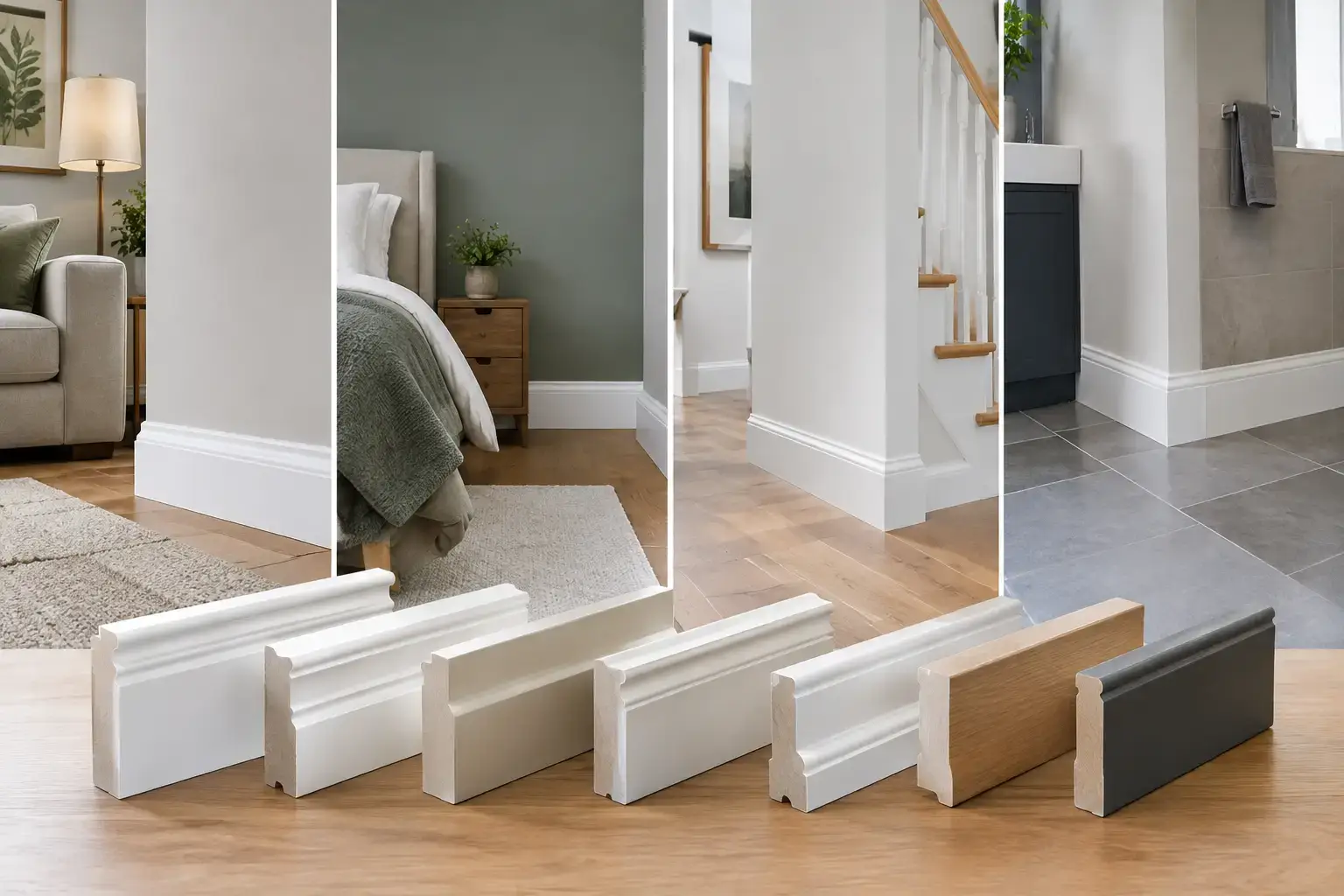
Choosing Skirting Board Profiles for Every Room
Compare skirting board profiles by style, height, material, and room use to create a refined finish that suits your doors, floors, and interior well.